

Vol. 02

The Sameness Trap:
A Well-Designed End to Your Company

I reviewed 50 well-funded security companies. All of them use the same ten words. But no worries - they are well designed.

By Yoav Vilner
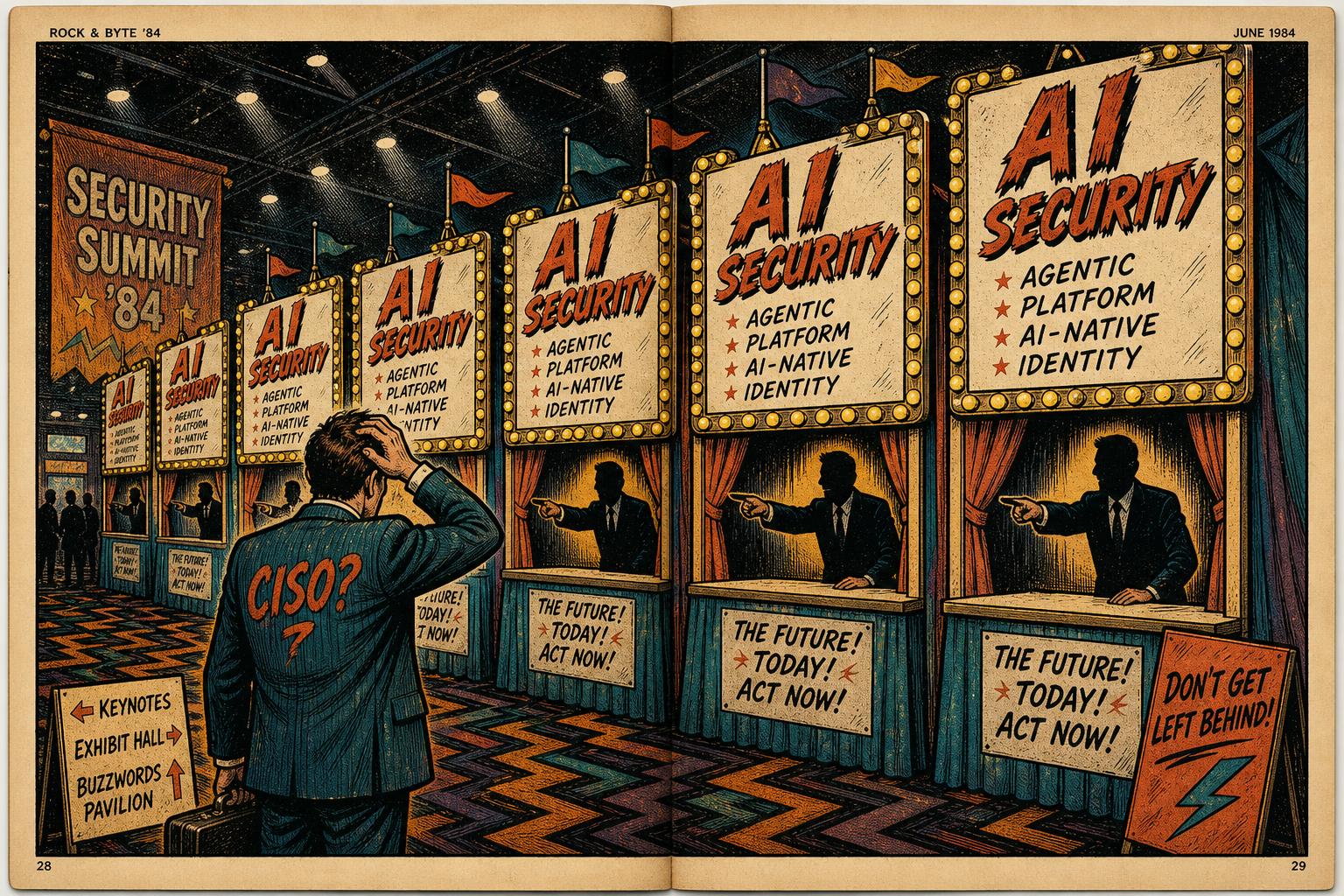
A vintage magazine cartoon showing a confused buyer at a row of identical AI Security booths.

Below are the first sentences from the homepages of several well-funded security companies, with the logos removed.

  • "Secure your data in the age of AI"
  • "Secure your enterprise agents"
  • "Stop chasing alerts. Start fixing what matters."
  • "Security that moves at the speed of AI."
  • "Control your AI"
  • "Enterprise security for AI agents"
  • "Endpoint security for the AI era"
  • "Securing the AI-native endpoint"
  • "Your entire attack surface, in one place."
  • "From code to cloud, unified."
  • "The AI-native platform for the AI era."
  • "Know what you have. Fix what's exposed."

Match them to the companies.

You can't. Neither can I. These companies have raised over a billion dollars between them, and every one of them arrived at nearly the same ten words. This isn't a content problem. A better headline won't fix it.

Vol. 01 was about the Storytelling Engineer. This issue is narrower: the story you're telling is already taken.

Prelude

One of the strategies that drove Walnut's growth in early 2020 - attracting 600 enterprise companies to a waitlist during a global pandemic - was identifying our audience's pain points more precisely than our competitors did.

As sales travel halted, CEOs feared their reps could no longer show the product, which increased friction between sales and the back-end teams: design, product, IT. By interviewing those stakeholders, I introduced the term "interactive demo" in March 2020.

It wasn't a grandiose vision, and investors were confused at first - so was Gartner. I spent that year explaining that "interactive" meant salespeople could work independently of back-end teams, using a codeless approach: Canva or Wix, but for demos. Today the demo industry is a funded category with over 100 competitors.

Category creation wasn't a choice. It was the only way.

Part One

The Map

I mapped the homepage stories of 50 active, funded security companies. They reduce to six. The entire industry's messaging surface fits on one page.

The Sameness Trap
Agentic
AGENTICAGENTICAGENTICAGENTICAGENTICAGENTICAGENTICAGENTIC
Platform
PLATFORMPLATFORMPLATFORMPLATFORMPLATFORMPLATFORMPLATFORM
Identity
IDENTITYIDENTITYIDENTITYIDENTITYIDENTITYIDENTITY
Context
CONTEXTCONTEXTCONTEXTCONTEXTCONTEXT
AI-Native
AI-NATIVEAI-NATIVEAI-NATIVEAI-NATIVE
Data
DATADATADATA
Posture
POSTUREPOSTURE
Cloud
CLOUD

The Six Stories

01

Context

"Everyone else gives you disconnected alerts. We connect them and tell you what actually matters."

context, graph, correlation, attack path, prioritization, noise, signal, unified

02

The Autonomous SOC

"Your analysts are drowning. Our AI agents do the tier-one work."

agentic, autonomous, triage, alert fatigue, force multiplier, works like your best analyst

03

Identity

"Machines now outnumber your employees. Nobody is watching them."

non-human identity, machine identity, secrets sprawl, service accounts, over-permissioned, the ratio is 45 to 1

04

Code to Cloud / ASPM

"Security tools were built for security people. We built ours for developers."

shift left, developer-first, code to cloud, reachability, false positives, friction, in the IDE

05

Securing AI

"Your company deployed AI faster than it secured it."

shadow AI, prompt injection, guardrails, AI visibility, agent governance, the new attack surface

06

Data

"You don't know where your sensitive data lives."

discovery, classification, data sprawl, lineage, DSPM, crown jewels

Six stories. Fifty companies. Eight companies per sentence.

The six are distinct on paper, and blurry in practice. Stories 1 and 4 end at the same promise - "we'll tell you which of these findings actually matters" - one arriving from the runtime side, the other from the code side. Stories 1 and 6 both sell knowing what you own before you defend it. Stories 2 and 5 both run on the word "agents," but in opposite roles: in one, agents do the security work; in the other, agents are the thing being secured. Only that second distinction survives a demo - the rest are differences of origin, not of promise.

So a CISO comparing these vendors isn't choosing between stories. They choose on price, analyst reports, or personal relationships.

Sameness forces the decision into the areas where you have no advantage.

Part Two

Why It's Happening Now

B2B sameness isn't new, but this density is the result of three things colliding.

First

AI collapsed the cost of building.

A two-year moat is now a month long. As product distance shrinks, positioning distance has to grow - and most companies did the opposite.

Second

AI collapsed the cost of writing.

Same models, same briefs, same outputs. LLMs return the statistical average of the category - the one place you cannot afford to stand. Companies think AI helps them move faster; often it just helps them converge.

Third

Funding structure.

The same funds, the same GTM playbooks, the same agencies. Pattern-matching helps when picking companies and hurts when positioning them.

None of this is anyone's fault. But please - please - stop using gnomes, apes, fish, and dragons to try to differentiate yourself from your many, many competitors. CISOs can't stand it anymore.

Part Three

What It Costs

Founders often mistake generic messaging for a branding issue. It goes deeper than that.

Sales cycles stretch

Not because of objections, but because of comparison. When buyers can't tell vendors apart, they run longer evaluations - and long evaluations cost you the deal.

Price ceilings get set for you

Generic positioning drops you into an existing category with a predefined ceiling. You're negotiating against a limit you didn't set.

Content stops compounding

Generic content doesn't build authority; it adds to the noise. That's why some of the most prolific companies in the category are never quoted.

Fundraising gets harder

If your positioning doesn't explain why you aren't just a "Wiz feature," you'll spend every meeting defending that instead of selling the future.

Part Four

A Company Problem,
Not a Copy Problem

Much like in The Storytelling Engineer, Vol. 01, companies today are built differently, with founders spearheading their own branding first. And in the same way, differentiating yourself in a crowded market comes down to how founders build their companies - not to how they word their homepage.

01

Stop Asking How You're Better. Ask Why You Exist.

Most positioning work starts by comparing features. That is already the wrong question. Comparison assumes the category is fixed and your only job is to score higher inside it.

Great companies are built around a belief, not an advantage. Advantages get matched within a quarter. Beliefs do not.

At Walnut, my company, we believed (and still do) that salespeople should be empowered to own their demos, and that prospects deserve a better experience.

02

Build the Company Around a Conviction, Not a Category

Categories explain what you sell. Convictions explain why only your company would build it. A category is a shelf; a conviction is a reason for the shelf to exist.

If your company disappeared tomorrow, what idea would disappear with it?

03

Find the Assumption Everyone Accepted by Accident

Industries converge because everyone inherits the same assumptions - usually from the first company that got funded, and never examined since.

Positioning isn't about finding a better adjective. It's about questioning the one assumption nobody else telling your story is willing to question out loud.

In my startup, we cursed sales demos to hell and said f*ck them!

04

Don't Win the Category. Redraw It.

The biggest companies in this industry did not become the best version of an existing category. They changed how the market thought about the problem, and the category rearranged itself around them.

Winning a category you inherited is a ceiling. Redrawing one is a compounding asset.

05

Positioning Is a Product Decision

Positioning shouldn't happen after product-market fit. It should influence what gets built, in what order, and what you deliberately refuse to build.

The strongest companies have roadmaps that reinforce their worldview. Every release is an argument for the same idea.

06

If Every Customer Agrees With Your Story, It's Probably Too Safe

Strong positioning creates tension. Some people should immediately identify with it. Others should reject it, loudly.

Indifference is the real enemy, not disagreement.

07

The Market Should Be Able to Predict Your Next Feature

Every launch should reinforce the same belief. When analysts and buyers can guess what you'll ship next - and they're right - your strategy is legible.

If new features feel random, the problem isn't the launch plan. It's the strategy.

08

Positioning Isn't Messaging. It's Company Design.

Messaging is the output. Positioning is the input, and it should shape product, hiring, roadmap, pricing, fundraising, analyst perception, and whether a new category exists at all.

If changing the homepage is enough to change your positioning, you never had positioning.

This is the one thing a founder cannot delegate. Not because it's important - plenty of important things get delegated - but because it isn't a task. It's a conviction, and everything else in the company is downstream of it.

In 2020, Walnut could have been a demo tool. Or a sales enablement product. Both were accurate, both were available, and either one would have placed us on a shelf someone else had already built - competing on features inside a category we inherited.

We named the interactive demo instead. Not a better description of the same thing, but a different claim about what the thing was: that a demo is not an asset salespeople request from someone else, but a product they build and own themselves.

That conviction decided what we built and what we refused to build, and the industry rearranged around it. There are over a hundred companies in that category now, and hundreds of millions of dollars in it. None of that existed when the only honest description of us was "demo tool."

Epilogue

Software ate the world. Then AI started eating software.

Building became cheaper. Writing became cheaper. Design became cheaper. Products started looking the same, and then websites started sounding the same.

For years, technology was the moat. Today, technology is copied in months. Messaging is copied in hours.

Fifty companies. Six stories.

The only thing competitors cannot copy is the founder's conviction.

Get in touch

Tell me what you're building.

"Strip the logo off your homepage. If your team can't pick it out of a lineup, neither can your buyer."